


TIMELINE
2025 - 2026
ROLE
Product Development
TYPE
Behavioral System Design
TOOLS
Python • Pandas • NLP • Streamlit
OVERVIEW
Snapshot
A behavioral recommendation system that maps emotional states to game based relief pathways. Built around one question: can games be matched to how someone wants to feel next?
GOAL
Design a structured recommendation logic that connects a user’s emotional state to game based relief pathways and keeps the system transparent, repeatable, and useful.
TOOLS USED
Python
Jupyter Notebook
NLP (NRCLex)
Pandas
Scikit-learn
Streamlit
KEY FINDINGS
• Emotional patterns in player reviews extend beyond traditional genre labels.
• Player review language could be converted into comparable emotional signals across games.
• Four emotional relief pathways shaped the recommendation logic: Comfort, Catharsis, Distraction, and Validation.
OUTPUT & IMPACT
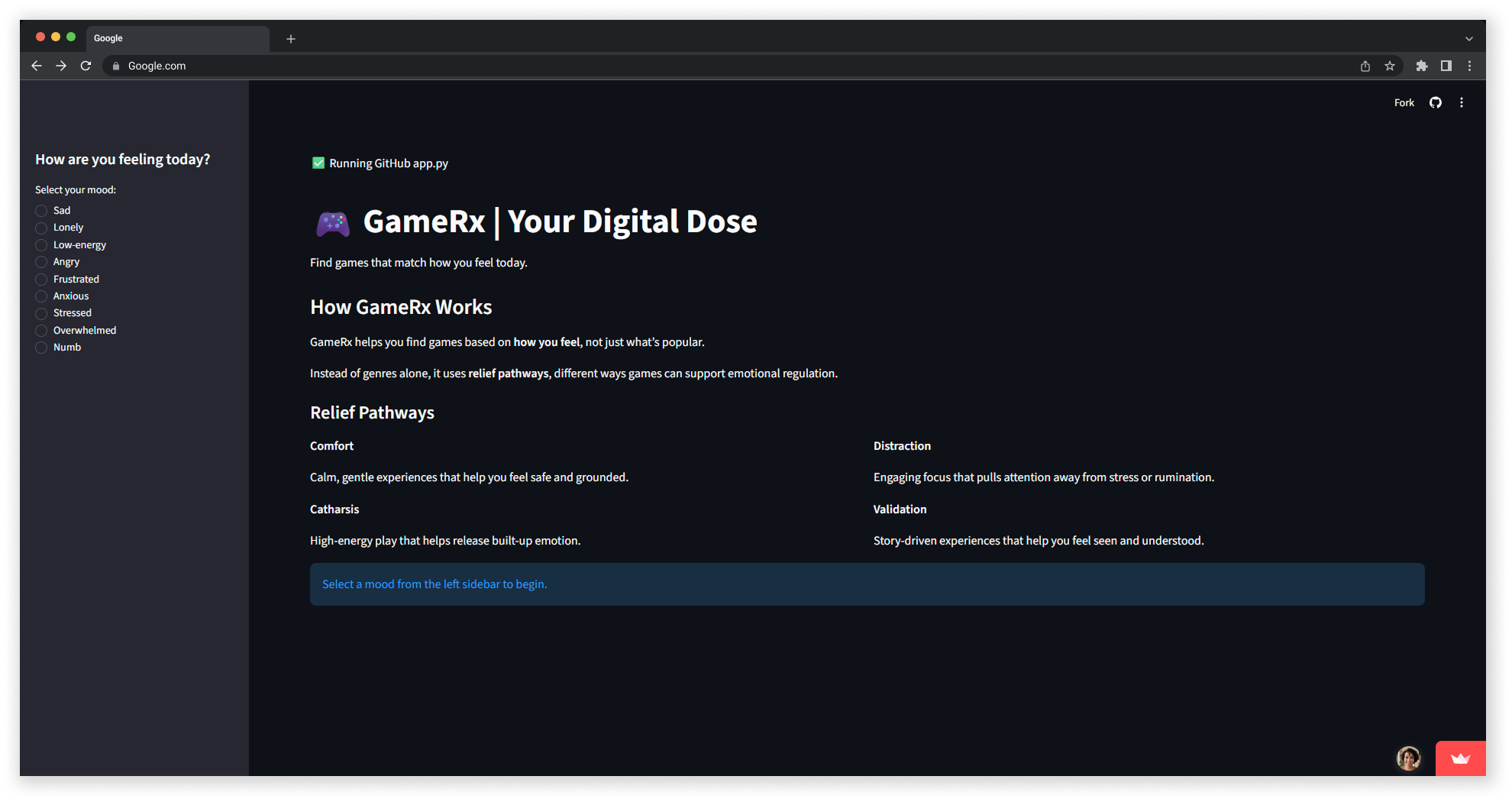
• Interactive Streamlit tool that returns game recommendations based on emotional relief needs.
• Reusable hybrid framework connecting emotional signals to structured relief pathways.
• AI-assisted prompts were tested and refined during the research workflow to improve consistency across evaluation and recommendation outputs.
1,000+
GAME RECORDS EVALUATED
Game records analyzed across emotional signals, genre context, and behavioral patterns.
4
RELIEF PATHWAYS
Comfort, Catharsis, Distraction, and Validation, each representing a different form of emotional support through play.
HYBRID
MODEL LOGIC
Review-based emotional signals were prioritized, with genre used as fallback and supporting context.
THE PROBLEM
The Challenge
Games are typically recommended by genre, ratings, or popularity, none of which account for how someone feels in the moment. The same game may not support every emotional need in the same way.
The challenge was building a system that could turn emotional signals from player reviews into structured relief pathways, connect those pathways to game context, and return recommendations that remained clear and explainable.
The core question: Can we build a repeatable logic that connects emotional needs to game based relief and works at scale?
-
Most game discovery tools prioritize popularity, ratings, or genre rather than emotional context.
-
Player reviews contain subjective language, uneven detail, and noisy emotional signals that need to be structured before comparison.
-
Emotional signals needed a clear framework that could translate them into meaningful game recommendations.
-
Recommendations had to be explainable, not just generated
“Players were already describing emotional experiences in their reviews. The challenge was turning that language into something the system could use.”
— THE OBSERVATION THAT STARTED THIS PROJECT
INPUT PREPARATION
Cleaning the data before trusting it
Before any modeling could begin, the data needed to be trustworthy. The raw reviews and game metadata included duplicates, missing values, inconsistent fields, and noisy language that could distort the emotional analysis.
I standardized metadata fields, removed duplicates, handled null and invalid records, and cleaned review text before emotion scoring. This reduced noise and made the emotional signals more consistent for comparison.
Why this matters: If the inputs are inconsistent, the recommendation logic will be too. Cleaning the reviews and metadata first gave the emotion analysis a more reliable foundation.
HOW I WORKED
Analytical Approach
The process started with data, not design. I needed to understand which emotional signals appeared in game reviews before building the recommendation logic.
01
Data preparation
Cleaned Steam reviews were linked with game metadata by AppID to create an analysis ready dataset.
02
Emotion mapping
Applied NLP with NRCLex to turn review language into emotional scores and identify patterns across player experiences.
03
Relief pathway modeling
Structured emotional signals into four relief pathways: Comfort, Catharsis, Distraction, and Validation.
04
Tool delivery
Built the hybrid logic into a Streamlit prototype that returns game recommendations by relief pathway.
WHAT THE DATA REVEALED
-
KEY FINDING 01
Emotional patterns formed overlapping clusters
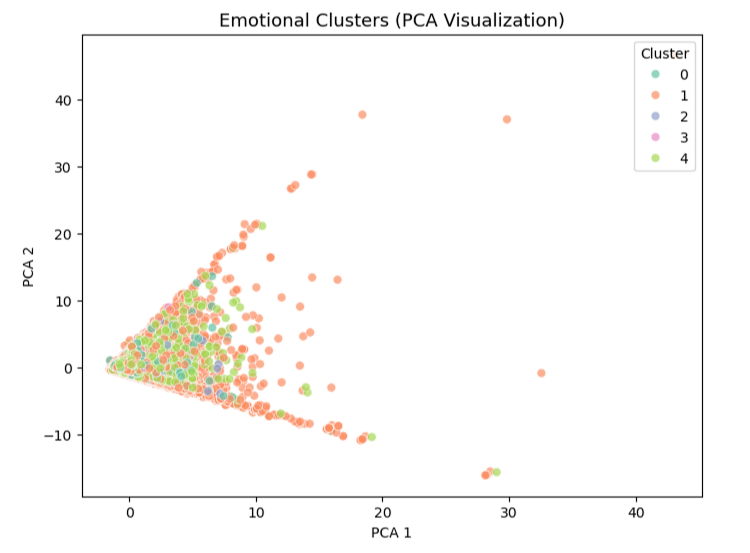
Clustering identified emotional groupings across games, but the PCA view showed substantial overlap between them. That overlap reinforced the need for a hybrid relief model rather than relying on cluster membership alone.
-
KEY FINDING 02
Relief pathways showed different emotional patterns
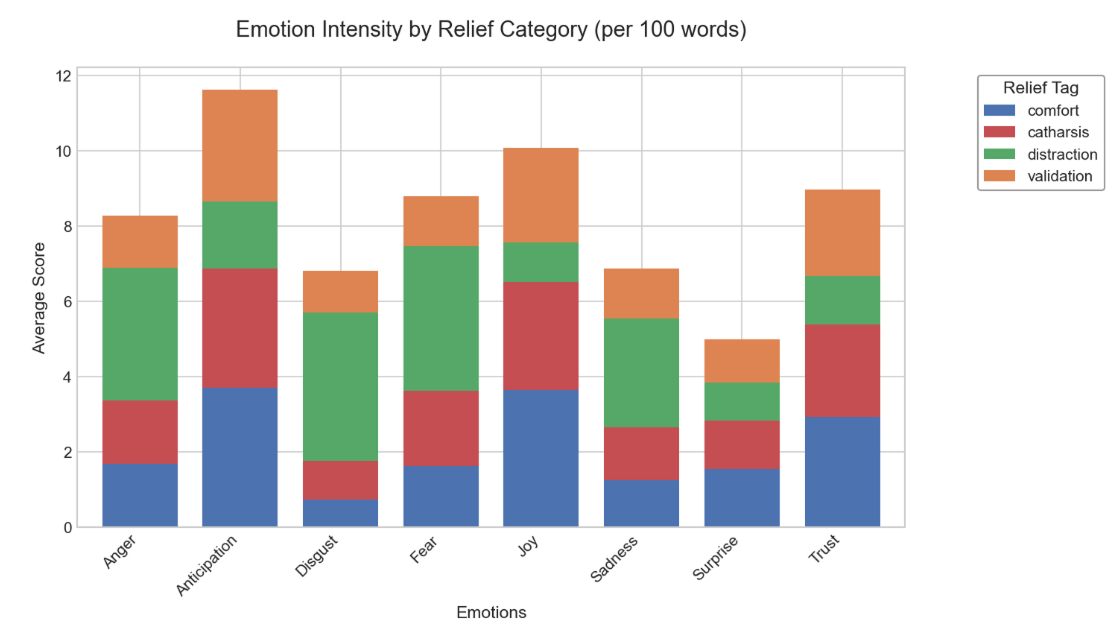
Comfort, Catharsis, Distraction, and Validation showed different mixes of emotional signals across the analysis. Those differences helped make each pathway more interpretable within the recommendation logic.
-

KEY FINDING 03
Relief pathways had distinct genre patterns
Genre patterns differed across the four relief pathways. Action appeared most strongly in Catharsis, Casual and Indie in Comfort, Simulation and Strategy in Distraction, and Adventure in Validation.
-
KEY FINDING 04
Joy and anger balanced differently by genre
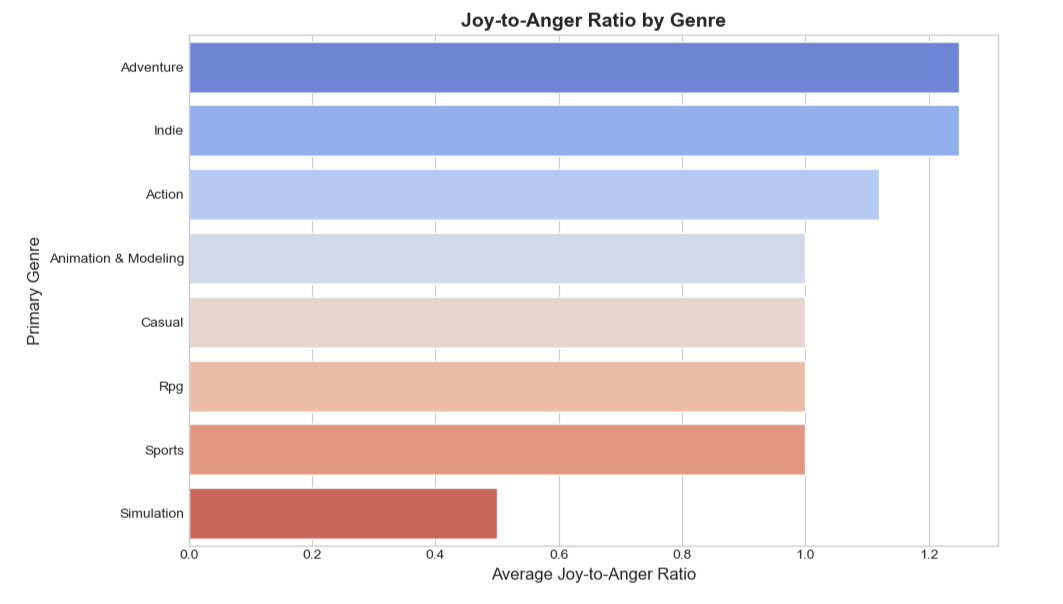
The balance between joy and anger varied across genres. Adventure, Indie, and Action leaned more toward joy, while Simulation showed a stronger relative presence of anger.
The insight that changed the logic: Review based emotion and genre context needed different jobs. Player language provided the emotional signal, while genre helped support and explain it.
WHAT I LEARNED
Main Insights
01
Context works better than assumptions
Genre became more useful when I treated it as context instead of emotional ground truth. That distinction helped keep the recommendation logic from making assumptions based on labels alone.
02
Language is a behavioral signal
NLP turned unstructured review language into emotional signals I could compare across games, but those signals still needed context to interpret responsibly.
03
Structure makes empathy usable
A structured relief framework did not remove the human side. It organized it. The hybrid logic made recommendations more repeatable while still leaving room for review, correction, and context.
04
Explainability matters
The Streamlit output needed to show why a game was recommended, not just return a result. Making the logic visible made the system easier to inspect, explain, and refine.
DECISION LOGIC
From Insight to Decision
Every finding shaped a product or design decision. I did not want GameRx to stop at analyzing emotional patterns. I wanted the logic to turn into something a person could actually use.
01
Finding
Genre alone was not enough
Recommendation
Made review based emotional signals the primary input, while genre and game context handled interpretation and fallback coverage.
02
Finding
Player language carried emotional signals
Recommendation
Used review language to identify emotional patterns and connect those signals to structured relief pathways.
03
Finding
Emotional intensity was not always negative
Recommendation
Kept stronger emotional signals in the logic instead of automatically treating them as negative or undesirable.
Growth as a Product Development Strategist: This project taught me that the hardest part was not just building the system. It was deciding what the system should pay attention to, what it should explain, and what it should avoid recommending.
EXPLORE THE WORK
-

Try the Streamlit app
Choose how you feel and explore game recommendations through the four emotional relief pathways. -

View the code on GitHub
The full Python project includes data cleaning, NLP emotion scoring, hybrid relief modeling, and the Streamlit app.